How to Revise Congenital and Inherited Syndromes with Multisystem Imaging Findings for the FRCR Part 2A
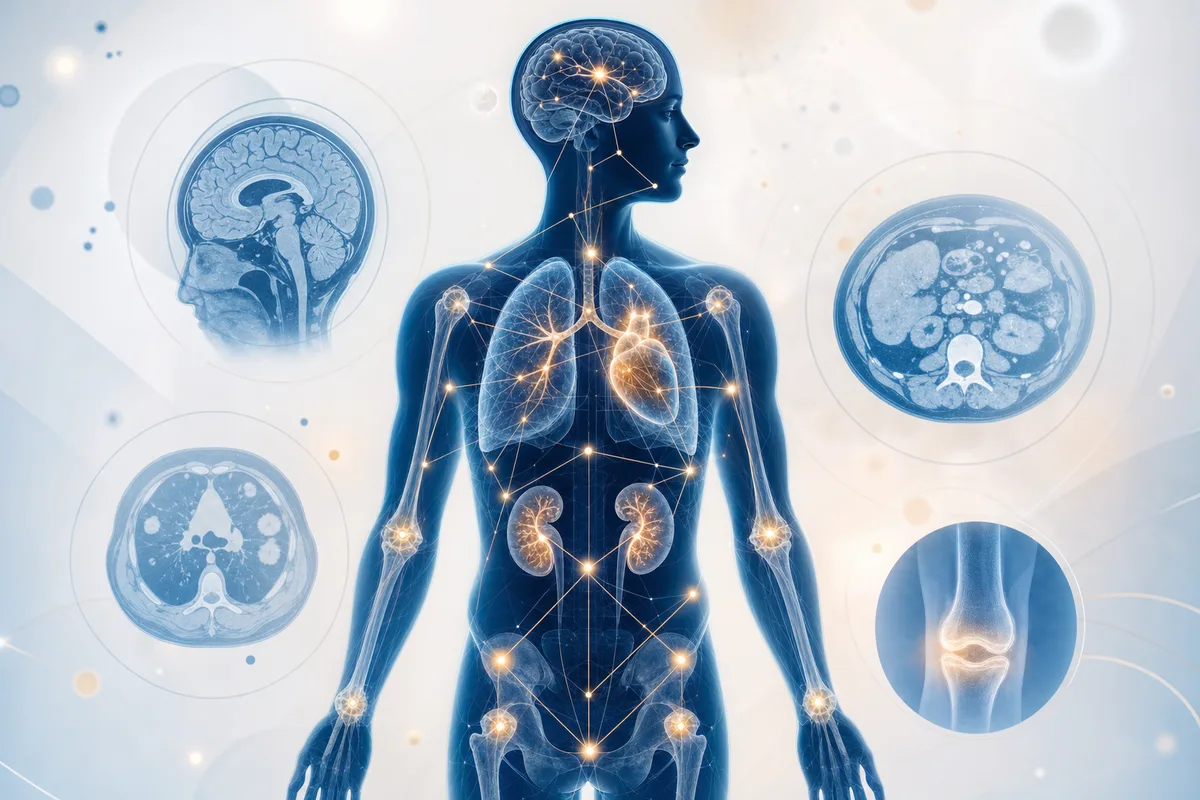
Syndromes are the questions that catch people out. You know the lung finding, you know the bone finding, but the exam shows you something in the kidney and suddenly you cannot connect the dots. That is the whole trick with inherited and congenital syndromes. They scatter their clues across the body, and the examiner wants to see if you can gather them up.
The good news? Once you learn to think in patterns rather than long lists, these questions become some of the most satisfying to answer. Let me show you how.
Why syndromes feel so hard
Most revision resources present syndromes as flat bullet lists. Twenty features, no hierarchy, no story. Your brain hates that. It struggles to hold ten unrelated facts about tuberous sclerosis in short-term memory, let alone recall them under exam pressure.
The problem is not that you are not working hard enough. It is that the information has no shape. Give it a shape and it sticks.
Organise by system, not by syndrome
Here is the shift that helps most trainees. Instead of memorising everything about one syndrome at a time, build a mental grid. Picture each syndrome running across the top, and each body system running down the side.
When you learn tuberous sclerosis, drill it system by system:
- Brain: subependymal nodules, cortical tubers, subependymal giant cell astrocytoma
- Kidney: angiomyolipomas, cysts
- Lung: lymphangioleiomyomatosis
- Heart: rhabdomyomas
- Bone and skin: sclerotic bone islands, ungual fibromas
Now do the same for von Hippel-Lindau, neurofibromatosis types 1 and 2, and so on. Suddenly you can compare across the grid. Which syndromes give you renal masses? Which give you CNS tumours? That cross-linking is exactly what single best answer questions test.
Find the one feature that clinches it
For almost every syndrome there is a near-pathognomonic finding, the one that makes you sit up. Train yourself to spot these.
- Bilateral vestibular schwannomas means NF2.
- Multiple renal cysts plus haemangioblastomas plus phaeochromocytoma points to VHL.
- Ribbon ribs, dural ectasia and plexiform neurofibromas lean towards NF1.
- Multiple colonic polyps with osteomas and desmoid tumours suggests Gardner syndrome.
In the exam, questions often hand you two or three features and ask for the diagnosis. If you have anchored each syndrome to its most specific finding, you can work backwards fast.
Group syndromes that like to travel together
Some syndromes share the same hunting grounds, and the examiner loves the overlap.
Phakomatoses (neurocutaneous syndromes): tuberous sclerosis, NF1, NF2, VHL, Sturge-Weber. Learn these as a family and compare their CNS, skin and visceral findings side by side.
Skeletal dysplasias: achondroplasia, osteogenesis imperfecta, cleidocranial dysplasia, thanatophoric dysplasia. Here the clues are in the bones. Think about the skull, the spine, the long bones and the pelvis in turn.
Vascular and connective tissue disorders: Marfan, Ehlers-Danlos, hereditary haemorrhagic telangiectasia. Aortic root, pneumothoraces, AVMs. These crop up in cardiac and chest stations.
Grouping like this means you revise related material together and build the comparisons the exam will ask you to make.
Use cases, not just lists
Facts learned in isolation fade. Facts learned through practice questions stick, because you attach them to a scenario. Every time you get a syndrome question wrong, you remember it far better than anything you simply read.
This is where working through plenty of single best answer questions pays off. SmashRad has over 12,000 exam-style questions with full explanations and Radiopaedia links, so when a tuberous sclerosis stem trips you up, you can read the reasoning and follow the link to consolidate the imaging. The separate Learning mode, built around bite-size recall questions, is ideal for the rote features of syndromes that you simply need at your fingertips. A free account gives you 40 sample questions to try the approach, no card required.
Draw it out from memory
Active recall beats passive reading every time. Once a week, take a blank page and try to reconstruct your syndrome grid from scratch. Write the system headings down the side and see how many features you can fill in without looking.
The gaps you find are exactly what to revise next. This is far more efficient than rereading notes you already half know. Your performance tracking in a good question bank does the same job automatically, flagging the modules where you keep slipping so you know where to spend your time.
Do not forget the paediatric angle
Many congenital syndromes present in childhood, and the FRCR tests paediatric imaging within several modules. Keep an eye on:
- Beckwith-Wiedemann and its link to Wilms tumour and hepatoblastoma
- Trisomy 21 with duodenal atresia, atlantoaxial instability and cardiac defects
- VACTERL association as a checklist of anomalies that cluster together
These appear across the paediatric, GI and musculoskeletal stations, so a little cross-system awareness goes a long way.
A simple weekly rhythm
Try this loop:
- Pick one syndrome family (say the phakomatoses).
- Build or review the system-by-system grid.
- Do a batch of questions on that family.
- Note what you got wrong and read the explanations.
- A few days later, recall the grid from a blank page.
Repeat with a new family each week. By the time your exam comes round, you will have cycled through the lot more than once, and the patterns will feel like old friends.
Syndromes reward the trainee who thinks in connections. Build the grid, anchor each one to its signature finding, and practise until the patterns surface on their own.
Ready to put this into practice? Start with the 40 free questions on SmashRad and see how quickly these syndromes start to click.
Put it into practice
SmashRad has 12,000+ exam-style and learning questions with full explanations and Radiopaedia links. Start free with 40 questions, no card needed.
Start free