How to Revise Endocrine and Head and Neck Glandular Imaging for the FRCR Part 2A
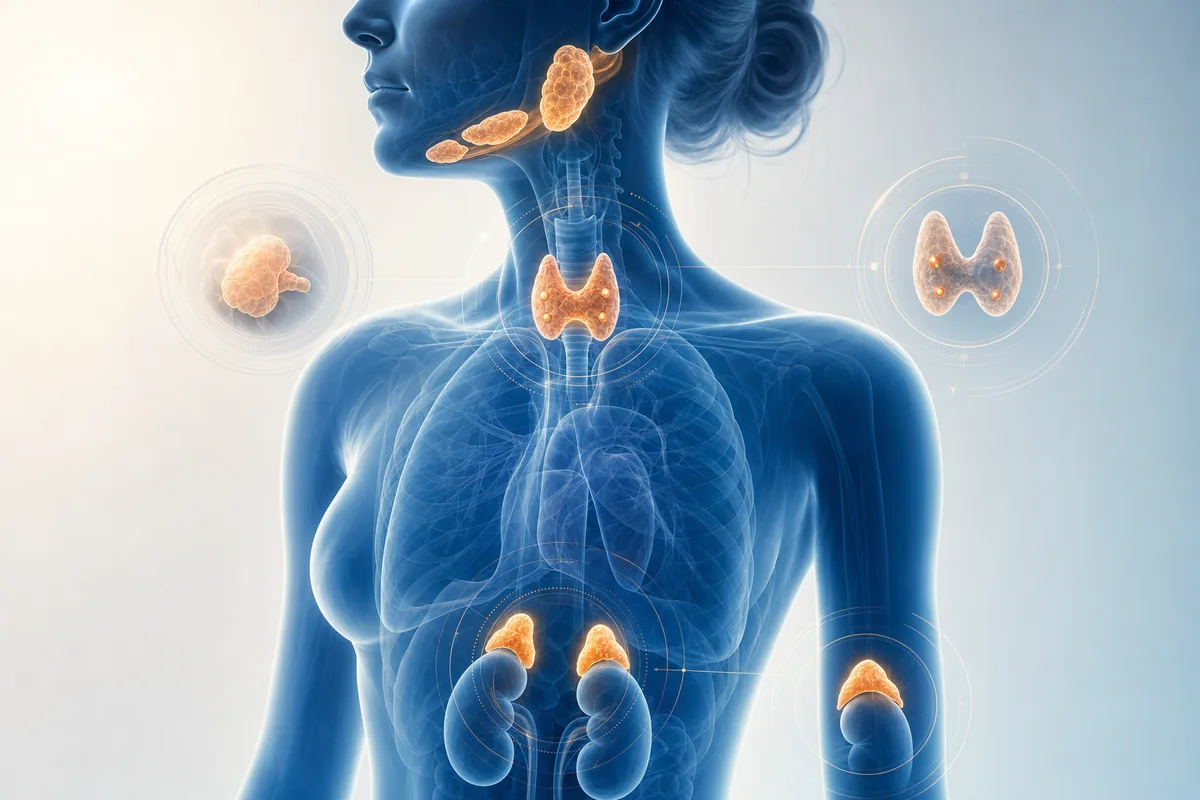
Endocrine and glandular imaging has a reputation for being fiddly. There are lots of small details, plenty of classification systems and a fair few exceptions to remember. The good news? It is also a reliable source of marks if you put the work in, because the questions tend to reward clear recall rather than clever reasoning.
Let us break it down gland by gland so your revision feels manageable.
Start with the thyroid
The thyroid turns up again and again, so make it your foundation.
Focus your effort here:
- Ultrasound features of malignancy: microcalcifications, taller-than-wide shape, irregular margins, marked hypoechogenicity. Know how these feed into risk stratification systems like U-classification and TI-RADS.
- Nuclear medicine basics: hot versus cold nodules, the role of technetium and iodine, and why a hot nodule is reassuring while a cold one needs attention.
- Thyroid cancer subtypes: papillary (most common, nodal spread, psammoma bodies), follicular (haematogenous spread), medullary (MEN associations, calcitonin), and anaplastic (elderly, aggressive, poor outcome).
- Thyroid eye disease: enlarged muscle bellies with tendon sparing, inferior and medial recti first.
A common exam trap is mixing up which cancer spreads where. Make yourself a tiny table and test it until it is automatic.
Parathyroids: small gland, frequent questions
Parathyroid adenomas love to appear in single best answer form. The classic scenario is primary hyperparathyroidism with a parathyroid adenoma, usually solitary and in a typical location posterior to the thyroid.
Key points to lock in:
- Sestamibi scanning and the dual-phase technique, with delayed washout from the parathyroid compared to the thyroid.
- Ultrasound and four-dimensional CT for localisation.
- Ectopic locations, particularly mediastinal and intrathyroidal, which examiners enjoy testing.
- The MEN syndromes and their associated tumours.
If you can confidently separate MEN 1, MEN 2A and MEN 2B, you will pick up marks across several modules, not just endocrine.
Adrenals: the great mimic
The adrenal gland rewards a systematic approach. Most questions revolve around characterising an adrenal lesion as benign or not.
Build your mental checklist:
- Adenoma: low attenuation on unenhanced CT (think 10 Hounsfield units or less), and absolute and relative washout values on the adrenal protocol CT. Know the cut-offs cold.
- Phaeochromocytoma: avid enhancement, cystic or heterogeneous appearance, the rule of tens, and MIBG uptake.
- Myelolipoma: macroscopic fat, which makes the diagnosis straightforward once you spot it.
- Adrenocortical carcinoma: large, heterogeneous, invasive, with areas of necrosis.
- Metastases: common, especially from lung, breast and melanoma.
Washout values are a classic point of confusion. Write out the formulas for absolute and relative percentage washout and practise them with numbers until they feel natural.
Salivary glands and the rest of the head and neck
The glandular head and neck topics stretch beyond the endocrine system, so do not neglect them.
Parotid and submandibular disease is the main focus:
- Pleomorphic adenoma: the most common parotid tumour, well defined, high T2 signal, small risk of malignant transformation over time.
- Warthin tumour: often bilateral, associated with smoking, and shows a particular behaviour on technetium pertechnetate scanning.
- Malignant tumours: mucoepidermoid and adenoid cystic carcinoma, with adenoid cystic known for perineural spread.
- Sialadenitis and sialolithiasis: the submandibular gland and Wharton duct feature heavily because stones are more common here.
Also give some time to Sjogren syndrome, the facial nerve relationship to the parotid, and the deep versus superficial lobe distinction.
A revision plan that actually works
Facts in this area are dense, and passive reading rarely makes them stick. Try this instead.
Build small comparison tables
For every pair that confuses you, make a two-column table. Papillary versus follicular. Adenoma versus phaeochromocytoma. Pleomorphic adenoma versus Warthin. Reviewing these takes minutes and pays off repeatedly.
Learn the numbers properly
Endocrine imaging is full of thresholds: Hounsfield unit cut-offs, washout percentages, the rule of tens. These are either right or wrong in an exam, so drill them as flashcards rather than hoping they will stick on their own.
Test, do not just read
Active recall is the single biggest upgrade you can make to your revision. Rather than rereading your notes, answer questions and see where you fall down. The gaps you find are the most efficient thing to study next.
This is where SmashRad earns its place. With over 12,000 exam-style single best answer questions, you can hammer the endocrine and head and neck topics until the patterns feel obvious. The separate Learning mode gives you bite-size recall questions, which are perfect for drilling those washout values and cancer subtypes. Every question comes with a full explanation and Radiopaedia links, so when you get something wrong you can close the gap straight away.
Track your weak spots
Per-module performance tracking shows you exactly where you are losing marks, and the revision recommendations point you to what to do next. When you feel ready, the timed mock exams let you practise under proper conditions, which matters more than most trainees expect.
Common pitfalls to avoid
- Confusing which thyroid cancer spreads by nodes versus blood.
- Forgetting that tendon sparing distinguishes thyroid eye disease from other causes of muscle enlargement.
- Mixing up absolute and relative adrenal washout formulas.
- Overlooking perineural spread as the hallmark of adenoid cystic carcinoma.
- Assuming all adrenal lesions need a biopsy when washout and fat content often answer the question.
Get these five right and you will already be ahead of many candidates.
Final thoughts
Endocrine and glandular imaging feels like a lot, but it is finite and very learnable. Break it into glands, build your comparison tables, drill the numbers, and keep testing yourself. The marks are there for anyone willing to be systematic.
Why not put it to the test right now? A free SmashRad account gives you 40 sample questions with no card needed, so you can see how your endocrine recall holds up and start closing the gaps today. Good luck with your preparation.
Put it into practice
SmashRad has 12,000+ exam-style and learning questions with full explanations and Radiopaedia links. Start free with 40 questions, no card needed.
Start free