How to Revise Vascular and Interventional Radiology for the FRCR Part 2A
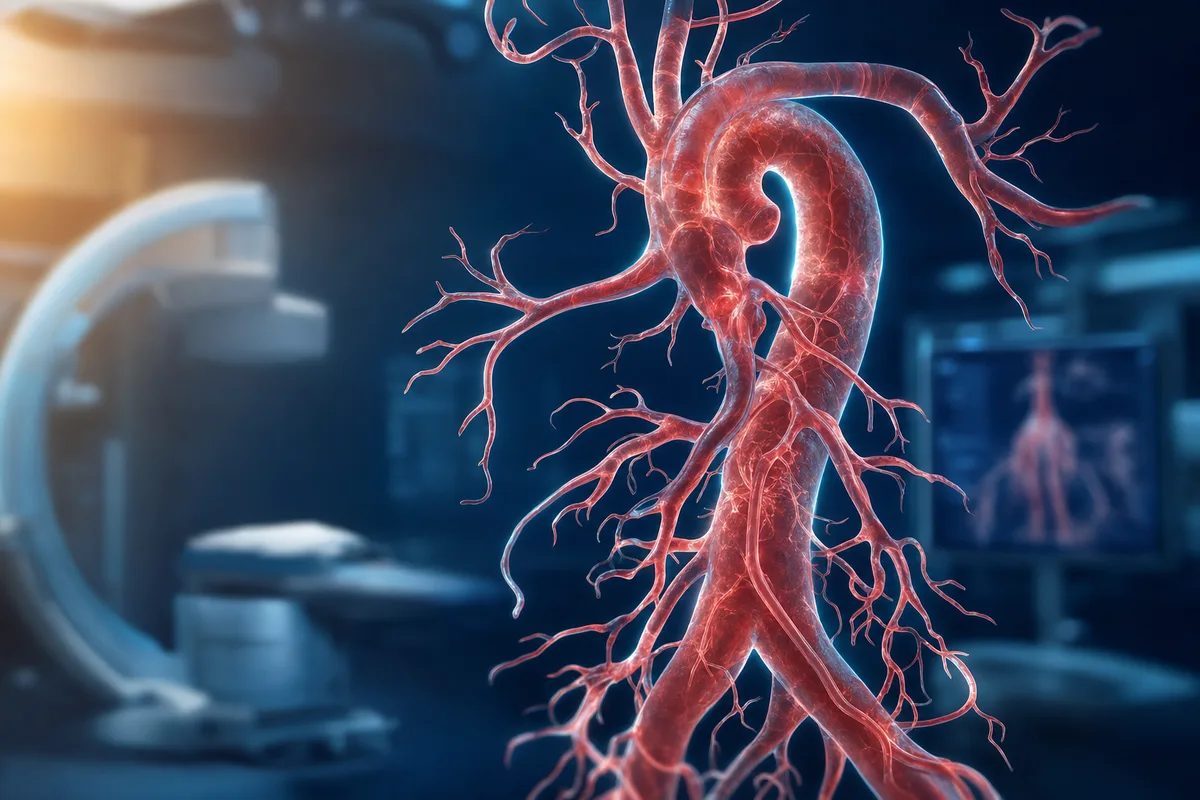
Vascular and interventional radiology (IR) can feel like the module everyone leaves until last. It is procedure heavy, jargon rich, and the anatomy is genuinely hard. But here is the good news: the FRCR Part 2A questions in this area are quite predictable once you know what the examiners love. Get the core topics solid and you can pick up marks that others drop.
Let me walk you through a sensible way to approach it.
Start with the anatomy, because everything hangs off it
You cannot answer a question about a bleeding gastroduodenal artery if you cannot picture where it sits. Vascular anatomy is the foundation, so spend your first block of revision here.
Focus on:
- The aortic arch and its branches, including common variants like a bovine arch and an aberrant right subclavian artery.
- Coeliac axis, superior mesenteric and inferior mesenteric arteries, plus the collateral pathways between them (arc of Riolan, marginal artery of Drummond).
- Renal arterial supply and accessory renal arteries.
- The circle of Willis and its common variants.
- Portal venous anatomy and the classic sites of portosystemic collaterals.
A quick tip: draw these out from memory rather than just reading them. If you can sketch the coeliac axis and its branches on a scrap of paper, you actually know it. If you cannot, you have found a gap.
Learn procedures as stories, not lists
Examiners like to test whether you understand why and how an intervention is done. Rote learning a list of steps rarely helps. Instead, think of each procedure as a short story: the indication, the access, the kit, the technique, the complications and the aftercare.
High-yield procedures worth knowing well include:
- TIPS (transjugular intrahepatic portosystemic shunt): indications, contraindications, and the classic complication of hepatic encephalopathy.
- Uterine artery embolisation for fibroids, including who is and is not a good candidate.
- Embolisation for GI and traumatic bleeding, and the difference between coils, glue and particles.
- Nephrostomy and biliary drainage, including safe puncture sites and complications.
- IVC filters: indications, retrievable versus permanent, and their problems.
- Angioplasty and stenting in peripheral arterial disease.
For each, ask yourself the same questions. What is the main indication? What is the single most feared complication? What would a stem describe if it wanted you to pick this answer? That last question is exam gold.
Get comfortable with embolic agents and access
This is a favourite corner of the module. Know your embolic agents cold: coils, particles (PVA), gelfoam, glue (NBCA) and Onyx. Understand which are temporary and which are permanent, and when you would choose each. A question about controlling arterial haemorrhage in trauma often hinges on picking a temporary agent like gelfoam.
Similarly, learn the common arterial access sites and their pros and cons, the Seldinger technique in principle, and the closure devices you might encounter. It sounds dry, but a handful of clean facts here answers a surprising number of questions.
Do not neglect contrast and radiation safety
Vascular work uses a lot of iodinated contrast and fluoroscopy, so the examiners weave in questions about contrast reactions, contrast induced nephropathy risk factors and radiation dose. These crossover topics are easy marks because you are probably revising them for physics anyway. Keep the management of a contrast reaction fresh in your mind, especially the doses for anaphylaxis.
Know the classic imaging signs
Single best answer questions love a recognisable sign. Build a mental list of the vascular ones, such as:
- The string of beads in fibromuscular dysplasia.
- The corkscrew collaterals in chronic mesenteric ischaemia.
- Pseudoaneurysm with its yin-yang flow on Doppler.
- The classic appearances of aortic dissection and the difference between true and false lumen.
When a stem describes one of these, you want instant recognition, not slow deduction.
Practise questions early and often
Reading is comfortable, but it lulls you into thinking you know more than you do. The fastest way to expose weak spots is to answer questions under exam conditions and then read the explanation carefully, whether you got it right or wrong.
This is where a good question bank earns its keep. SmashRad has over 12,000 exam-style single best answer questions with full explanations and Radiopaedia links, so when you meet an unfamiliar embolic agent or an odd bit of collateral anatomy, you can read around it straight away. The separate Learning mode of bite-size recall questions is handy for drilling the pure facts, like which agent is permanent or where a nephrostomy is safely sited. The per-module tracking will quickly show you whether vascular is a strength or a soft spot, and the revision recommendations point you back to weak areas before they cost you marks.
Try a few timed mock exams as your date approaches too. Vascular questions can be wordy, and getting used to the pace stops you panicking on the day.
A simple week-by-week plan
If you like structure, try this:
- Week one: vascular anatomy, drawn and re-drawn until it sticks.
- Week two: core procedures as stories, plus embolic agents.
- Week three: crossover topics (contrast, radiation, complications) and classic signs.
- Week four: pure question practice, reviewing every explanation and hammering your weak modules.
Adjust the timings to suit your schedule, but keep question practice running throughout, not just at the end.
Final thoughts
Vascular and IR rewards a bit of respect and a clear plan. Nail the anatomy, understand the procedures rather than memorising them, and test yourself relentlessly. Do that and this becomes one of your more reliable modules rather than the one you dread.
Why not start now? You can practise 40 sample questions free on SmashRad without even entering a card. Answer a handful of vascular questions today and see exactly where you stand.
Put it into practice
SmashRad has 12,000+ exam-style and learning questions with full explanations and Radiopaedia links. Start free with 40 questions, no card needed.
Start free