How to Revise Gastrointestinal and Hepatobiliary Imaging for the FRCR Part 2A
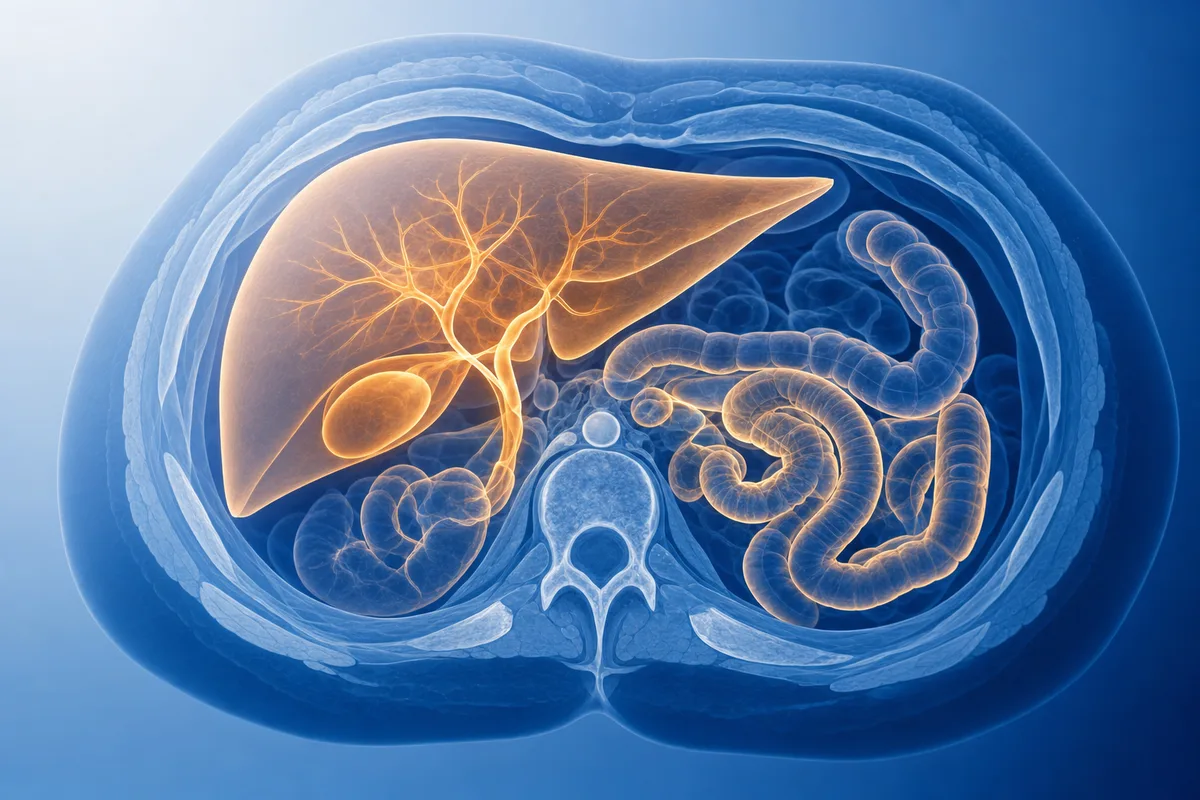
Gastrointestinal and hepatobiliary imaging is one of the biggest slices of the FRCR Part 2A. It is also one of the most rewarding to revise, because so much of it is pattern recognition once the underlying logic clicks. The trouble is the sheer breadth. You have the whole gut from mouth to anus, the liver, biliary tree, pancreas, spleen and peritoneum, across every modality. It can feel bottomless.
Let me show you how to make it manageable.
Start with a map, not a mountain
Before you open a single question, split the topic into digestible chunks. Trying to "do GI" in one sitting is a recipe for feeling swamped. A sensible breakdown looks like this:
- Oesophagus and stomach
- Small bowel
- Large bowel and appendix
- Liver (diffuse and focal)
- Biliary tree and gallbladder
- Pancreas
- Spleen and peritoneum
- Fluoroscopy and contrast studies
Give each block a couple of focused sessions rather than one marathon. Rotating through them keeps things fresh and helps recall stick.
The high-yield topics that keep coming up
Examiners love reliable, discriminating facts. These themes turn up again and again, so make sure they are solid.
Liver lesions
The classic enhancement patterns are exam gold. Know the arterial, portal venous and delayed appearances cold for:
- Haemangioma (peripheral nodular discontinuous enhancement, fill-in)
- Focal nodular hyperplasia (central scar, homogeneous arterial enhancement)
- Hepatic adenoma (and its link to oral contraceptives and glycogen storage disease)
- Hepatocellular carcinoma (arterial enhancement with washout, capsule)
- Metastases and the differences between hypervascular and hypovascular deposits
Add cirrhosis morphology, portal hypertension signs and the vascular complications, since these link neatly to other modules.
Biliary and pancreas
Get comfortable with the causes of biliary dilatation and how to localise the level of obstruction. Know the MRCP appearances of primary sclerosing cholangitis, cholangiocarcinoma (including Klatskin tumours) and choledochal cysts (the Todani classification is worth a look). For pancreas, nail acute pancreatitis and its complications, chronic pancreatitis, and the cystic lesions (serous cystadenoma, mucinous cystic neoplasm, IPMN, pseudocyst). Autoimmune pancreatitis with its sausage-shaped gland is a favourite.
Bowel
Crohn's versus ulcerative colitis is a perennial. Learn the distribution, wall changes, complications and extraintestinal features. Small bowel obstruction, ischaemia and the imaging of appendicitis and diverticulitis all reward clear thinking. Do not neglect the fluoroscopy: barium swallow and follow-through findings, the appearances of achalasia, strictures, fistulae and postoperative anatomy still appear.
Congenital and paediatric crossovers
Malrotation, midgut volvulus, intussusception and hypertrophic pyloric stenosis often sit under the GI banner. A few clean facts here score easy marks.
Learn the way the exam tests you
The FRCR Part 2A is single best answer. That means the skill is not just knowing a fact, it is picking the most likely answer from plausible distractors. You need to recognise the discriminating feature that separates option A from option B.
The fastest way to build that instinct is deliberate question practice. Read the stem, commit to an answer, then read the full explanation whether you got it right or wrong. The explanation is where the learning happens. Over time you start to spot the buzzwords: the central scar, the target sign, the double duct sign, the comb sign.
This is where SmashRad earns its keep. It has over 12,000 exam-style single best answer questions with per-module tracking, so you can drill GI and hepatobiliary specifically and see exactly where you are leaking marks. Each question comes with a full explanation and Radiopaedia links, so if a liver lesion trips you up you can read around it straight away without losing momentum. There is also a separate Learning mode of bite-size recall questions, which is perfect for hammering home those enhancement patterns and classifications before you move to full exam-style practice.
A simple weekly rhythm
Here is a plan that works for most trainees revising alongside a busy job:
- Pick one sub-topic (say, focal liver lesions).
- Spend 30 to 45 minutes on active recall using bite-size questions or your notes.
- Do a set of exam-style questions on that sub-topic.
- Review every explanation, and jot down the facts that surprised you.
- Come back to those weak points in a mixed question set a few days later.
That spacing matters more than raw hours. Revisiting a topic after a short gap forces your brain to work for the answer, and that effort is what builds lasting memory.
Common traps to avoid
- Reading passively. Highlighting a textbook feels productive but rarely sticks. Test yourself instead.
- Ignoring fluoroscopy. It feels old fashioned, but it still appears and the marks are there for the taking.
- Skipping the boring anatomy. Segmental liver anatomy and vascular variants underpin a lot of questions.
- Cramming the classifications last minute. Todani, Bismuth, Balthazar and the like are far easier if you meet them early and revisit them.
Track your progress and trust the data
One of the quiet advantages of question-based revision is that it tells you the truth. If your GI score keeps sitting below your average, that is your cue, not your ego's. Use per-module performance tracking to steer your remaining time toward the areas that need it, and lean on the revision recommendations rather than guessing. A couple of timed mock exams in the final stretch will also sharpen your pacing, which matters more than people expect on the day.
GI and hepatobiliary imaging rewards steady, active revision more than any last-minute heroics. Break it up, drill the high-yield patterns, and let the explanations teach you.
Ready to test yourself? A free SmashRad account gives you 40 sample questions with no card needed, so you can try a GI set today and see where you stand. Good luck, you have got this.
Put it into practice
SmashRad has 12,000+ exam-style and learning questions with full explanations and Radiopaedia links. Start free with 40 questions, no card needed.
Start free